

Connection Report: Week 1
It may all be connected, but do you always want to connect?

See this?
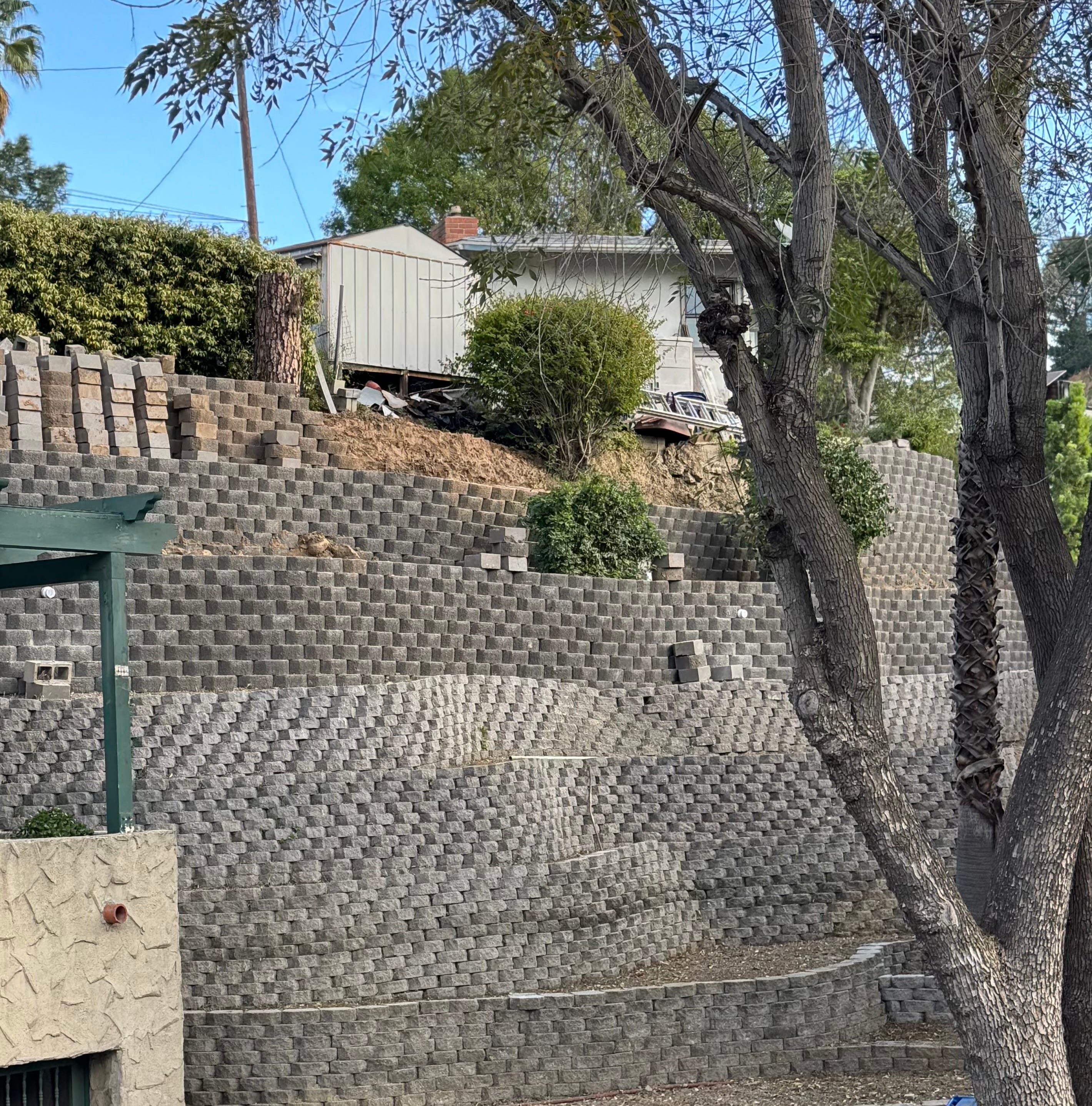
This is what I see when I look out from my terrace, and it’s driving me out of my fucking mind.
It didn’t always look like this. A year ago, it looked liked this.
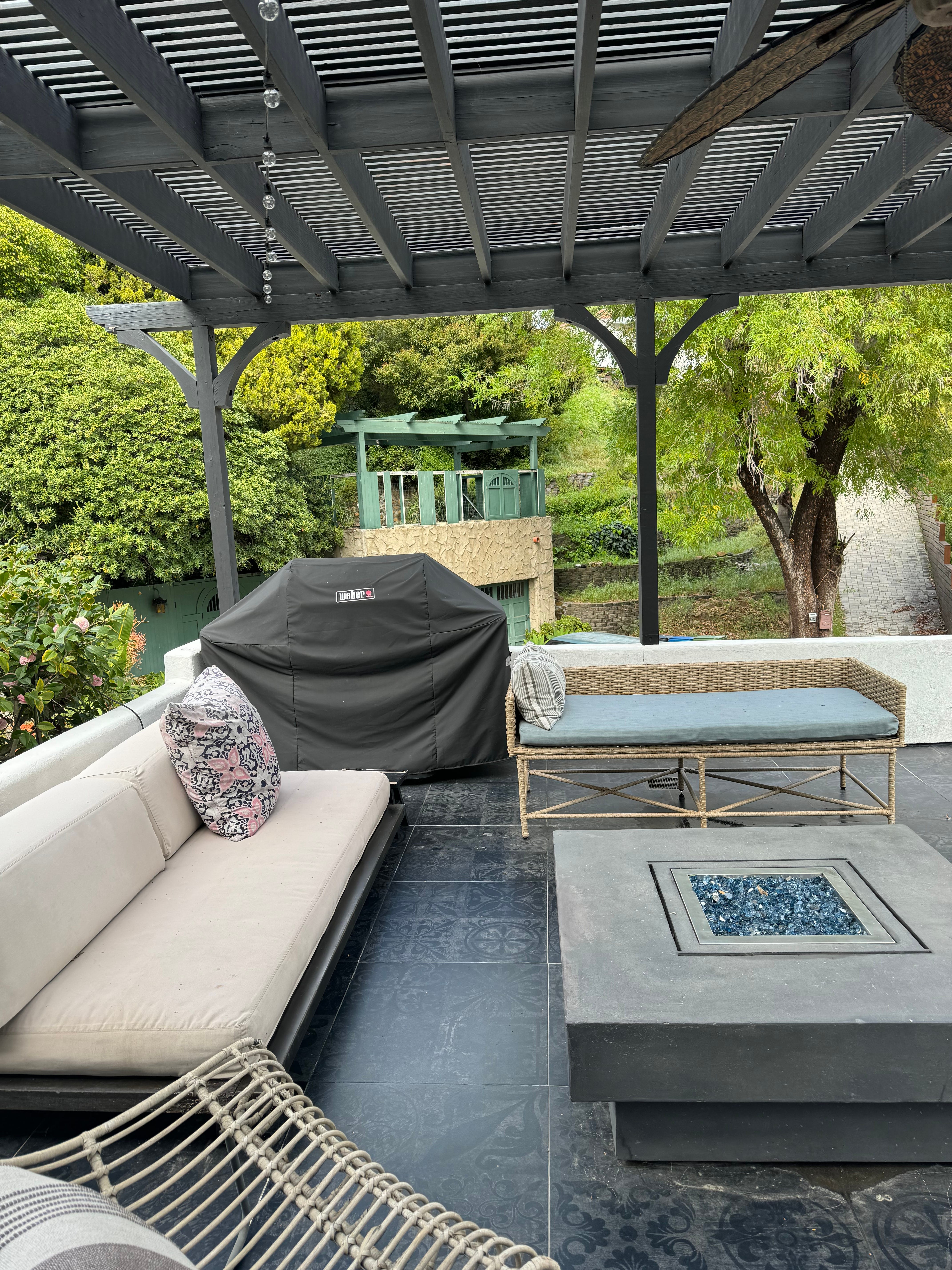
Pretty, right?
And now, from the same view, we see this.
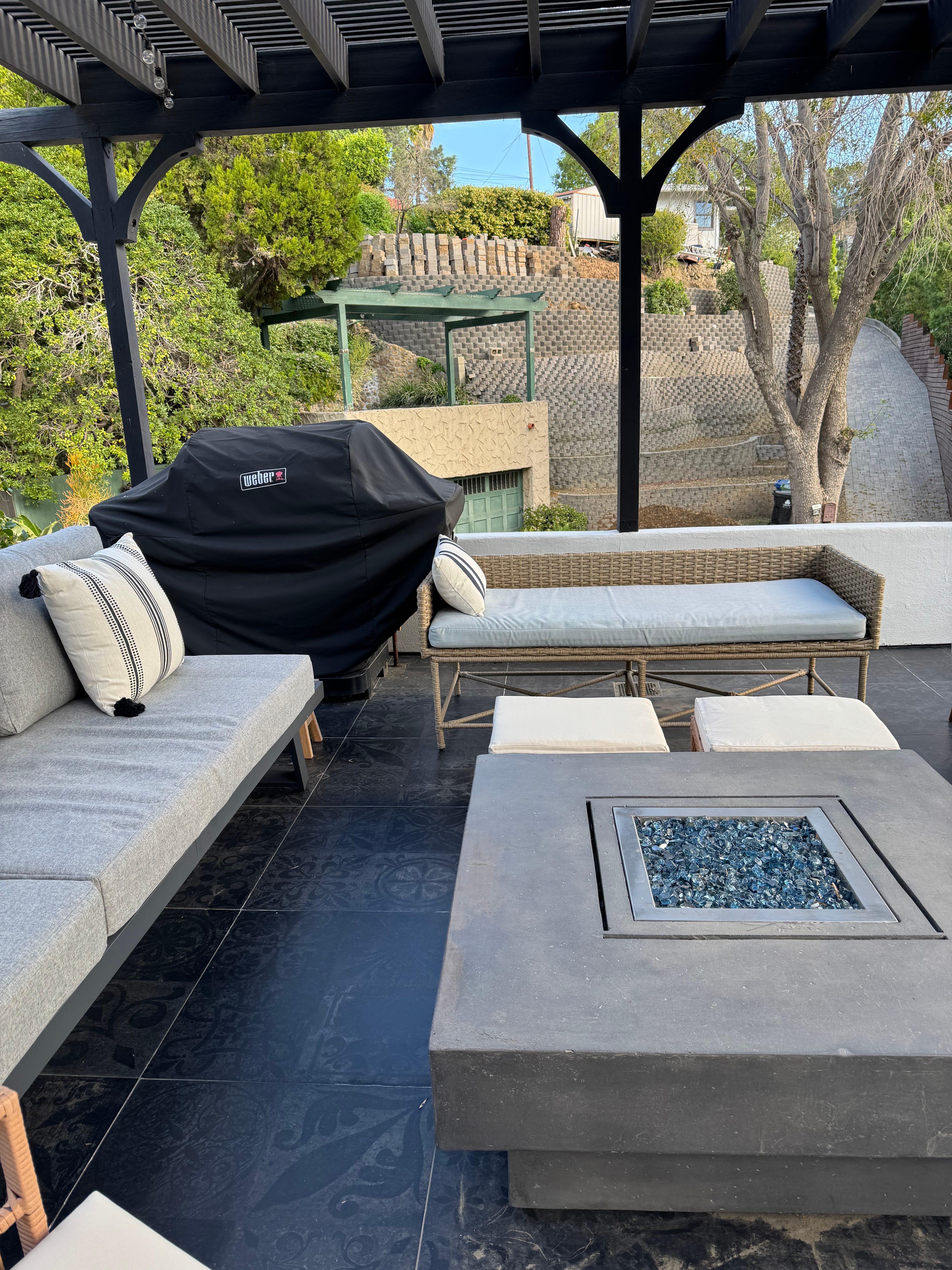
It looks like Jeff Bezos’s yacht. Or a Salvadorian prison. Or a quarry.
I know, in the land of mudslides, that walls like this are necessary. All things considered, I’m grateful that my neighbor built it.
I hated the way it looked, but when the rains came at Christmas, and the whole thing sprouted grass on every ledge and vines poking through every goddamn cinderblock, I was so happy. The stone wall was verdant, softened. Everything was going to be okay.
And then I returned from my week away to find the entire wall shorn of its greenery. I was sitting at my dining room table, texting a rant to my neighbors in the cul de sac, who I don’t even know — LA looks like the suburbs, but acts like the city — when in the driveway beside the wall I saw the person who presumably built it.
I had never seen this wall-building neighbor before, never even seen a car go up or down that driveway. But I knew via my gardener — don’t be impressed, everybody here has one — that it was “a lady, tall, pretty old.” This had to be the one.
Remembering my Word of the Year, Connection, I stopped typing mid-text and decided to connect face-to-face.
I ran outside and went right up to my offending neighbor, hand outstetched, and introduced myself. She looked shocked, but shook my hand and introduced herself as Gigi, like the Colette novel. (This is not her real name, but it’s the right vibe.) She was easily in her mid-eighties, pretty, looking kind of like Annette Bening in a remake of On Golden Pond.
“I was thrilled after the rain when everything turned green,” I told her, smiling. “Why did you pull it all up?”
“Those were weeds,” she said.
“Yes, but they looked good. Are you going to plant something in their place?”
Oh, yes, Gigi assured me. Tangerine trees and bougainvillea. And so many other things.
I told her I was really happy to hear that, because from my terrace….
I pointed toward my house, and then I thought, Why try to describe to her how bad the wall looks? Why not let her experience it from my house? So I invited her over for a drink. I was all about Connection now, I told myself. And I had a better chance of getting her to plant the wall, I figured, by being her friend than an enemy or a stranger.
Two days later, at 5 pm on the dot, Gigi arrived. It was chilly, but I led her with her Lacroix out to the terrace. Showed her a seat with a good view of the prison wall and started asking her questions that forced her to face it. What was that small building on the left? Could she see my house from that window? But she kept turning back to me, telling the kind of “stories” that seem emblematic to my parents’ generation, when everyone sounded like those regular features in Reader’s Digest: My Most Unforgettable Character and This American Life.
“Now, my mother’s youngest sister, she wanted to get her divorce, but my grandmother said no, there would be no divorce in the family, and don’t you know, they stayed together until the day that they died.”
I kept trying to draw her attention back to the wall, kept expecting her to say, Wow, that wall really does look like shit. I’ll get something planted there right away.
But that didn’t happen. Instead, she just kept talking and talking and talking about things that were not only not interesting to me, but that couldn’t possibly be interesting to anybody. The only interesting thing was how long she was able to keep this up, with seemingly no self-consciousness of how mind-numbingly boring her soliloquoy was.
And then it hit me: The person who can hold forth like that is the same as the person who can build that wall. Why did I imagine that anyone who built that wall would be able to see it through my eyes? The wall, the hulking gray stone wall in an otherwise pastoral green canyon, could only be created by someone who was either oblivious or didn’t give a shit.
In fairness, from where Gigi sits, in her house, she can’t even see the wall. She can pretend that it, and me, don’t even exist.
Whereas all I see is wall. I know now, though, that Gigi will either plant a tangerine tree on her terrace or she won’t, but it won’t be because of me. I bet she’ll get sick of paying people to pull the weeds before she recreates the Hanging Gardens of Babylon.
And that’s fine with me. From my own selfish perch, all I care about is how it looks.
The moral of the story: Connection isn’t always positive.
In Montclair, my neighbors became some of my best friends and still are: Hi, Alexa! Hi, Murry! Hi, Celia and Karen!
Alexa is a wonderful photographer who I’m trying to convince to take pictures of old women naked, as she did for pregnant nudes with her book Ripe. Are her photos not fabulous? Do you want her to do a similar series with old women? Plus Alexa just got a place in LA, so I’m gonna see her all the time.
And Murry came all the way from Little Rock to see Old Woman Naked in New York. Here we are, hugging. I look like I’m collapsing into her arms, and maybe I was. Murry and I were desperate housewives together 20 years ago our youngest sons best friends, both unhappily-married newcomers looking a kindred soul. She still feels like someone who will love me just the way I am.

Los Angeles isn’t a cozy neighborly suburb like Montclair, though, and your neighbors are liable to be people you don’t want to talk to outside of an earthquake. In fact, neighbors are often aggressively non-friendly here, issuing a terse hi but pointedly indulging in no chitchat, tendering no invitations. My 103-year-old neighbor invited me over once, then disinvited me. After Gigi, I get the point.
Connection has been good too.
I read a really interesting piece in the Times about near-death experiences , something I’ve been thinking in the context of Old Woman Naked, whether we have a spirit that lives on after we die or our bodies are all there is.
I was fascinated by the survivors in the piece, who were enjoying their lives to the utmost and also feeling comforted by the experience of what happens next. People described great swells of emotion and memory, a sense of being surrounded by love and at one with the universe. I liked the piece so much I went back to the top to see who’d written it. And it was Jessica Grose, someone who’d been my editor at the Times a few times years ago.
I emailed Jessica to tell her how much I liked the piece, and she emailed back that it meant a lot coming from me, a really sweet exchange across the years, especially given the article’s discussion of synchronicity and its connection to my play.
And I also connected with a growing network of generous theatre friends, who are excited about the possibilities of Old Woman Naked. I have a final script, which has been met with enthusiasm. The New York Times piece will be scheduled once I have a theatre date, which I hope is soon. I’m very excited to introduce this play to the wider world.
I adored reading this! Read it twice, for the sheer joy of your sentences. I need to learn to write like you! I also thought, since I'm rereading Howards End, that it is PERFECT you address yourself to walls in this first week's report, since Forster himself talks a great deal about walls, and how people like the businesslike Wilcoxes live behind them, fortressed and obtuse, and that if the walls ever do come down, there is basically just panic and emptiness. Of Mr Wilcox: "At times his forehead 'had the effect of a blank wall. He had dwelt behind it, intact and happy, for 50 years.'" Also: "He was obtuse. He simply didn't notice things . . . he never noticed the lights and shades that exist in the greyist conversation, the finger-posts, the mile-stones, the collisions, the illimitable views." Well, you no longer have an illimitable view because there is this Wilcoxian imperious obtuse incurious narcissist living beside you. But I have to say that this adventure seems to be perfect. It was because of people like the Wilcoxes that Forster exclaims we need to connect, at least with ourselves! (I apologize if I've become pedantic! I am immersed in reading Howards End right now, advancing at a caterpillar's pace in order to track it . . .)
First, I loved this story. Second, I was really, really hoping that your neighbor was going to be a connection for you and that you would be wonderfully surprised about how wonderful she was.